S · P · Q · R

A Recommended Reading Guide

These are books that I personally recommend. They have given me a more complete picture of the period. I'm always looking for new books to read. Let me know what I missed.

28Volumes
23Non-Fiction
5Fiction
The Library

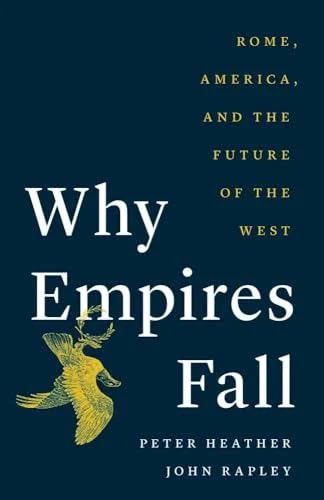
Why Empires Fall

Peter Heather and John Rapley

2024Non-Fiction US / Rome Comparison

A historian of late antiquity and a political economist team up to argue that Rome did not collapse from internal decadence but from a long, structural shift of wealth and power to its periphery — and they suggest the modern West is now living through an eerily similar transition.
Are We Rome?

Cullen Murphy

2008Non-Fiction US / Rome Comparison

Murphy draws six pointed parallels between imperial Rome and modern America — on borders, privatization, the capital city, the military, civic complacency, and the view of outsiders — to ask which lessons actually transfer and which are myth.

SPQR: A History of Ancient Rome

Mary Beard

2016Non-Fiction General History

Beard's modern survey of Rome's first thousand years, from a muddy village to a Mediterranean superpower. She is skeptical of the old heroic legends and especially good on ordinary Romans — slaves, soldiers, women, and provincials.

Roma: The Novel of Ancient Rome

Steven Saylor

2008Fiction Historical Fiction

A sweeping family saga that follows a single bloodline across a thousand years of Roman history, from the salt traders at the Tiber crossing to the dictatorship of Caesar — a heirloom amulet binding the generations together.

The Seven Wonders

Steven Saylor

2012Fiction Historical Fiction

A coming-of-age mystery in which young Gordianus tours the Seven Wonders of the Ancient World on the eve of his 18th birthday and stumbles into a murder at every stop. A grand tour of the Hellenistic world just before Rome swallows it.

The Ghosts of Cannae

Robert L. O'Connell

2010Non-Fiction Punic Wars

A military history of Hannibal's annihilation of a Roman army at Cannae in 216 BC — and of the disgraced legionary survivors who were exiled to Sicily and eventually used by Scipio Africanus to break Carthage.

The Later Roman Empire

Ammianus Marcellinus

c. 370 ADNon-Fiction Late Empire / Military

The surviving books of the last great Latin historian — a Greek-speaking soldier who served under Julian and wrote an eyewitness account of the 4th-century empire, culminating in the catastrophe at Adrianople in 378.

Imperium

Robert Harris

2006Fiction Historical Fiction — Cicero

Cicero's rise to the consulship, narrated by his slave-secretary Tiro. The first volume of Harris's Cicero trilogy: a political thriller about prosecution, oratory, and the ruthless mechanics of late-Republican Rome.

Pax Romana

Adrian Goldsworthy

2016Non-Fiction Entire History

Goldsworthy asks what the famous 'Roman peace' actually felt like for the people who lived under it — sometimes prosperity and law, sometimes garrisons and tax collectors — and how the empire really kept order across three continents.

Founders of the Western World

Michael Grant

1991Non-Fiction Greek and Roman

A combined history of Greece and Rome from a veteran classicist, tracing the institutions, art, and ideas that the two civilizations passed down to the modern West.

A War Like No Other

Victor Davis Hanson

2005Non-Fiction Peloponnesian War

Not Rome but its essential prequel: Hanson reorganizes the Athens–Sparta war by type of fighting — fire, disease, terror, walls, horses, ships — to show how a 27-year conflict reshaped Greek civilization and set the template Rome would inherit.

Dictator

Robert Harris

2015Fiction End of the Republic — Cicero

The final volume of the Cicero trilogy: exile, the rise of Caesar, the Ides of March, and Cicero's doomed last stand against Mark Antony. The death of the Republic told from inside its losing side.

Alaric the Goth: An Outsider's History of the Fall of Rome

Douglas Boin

2020Non-Fiction Sack of Rome — Alaric

A biography of the Gothic king who sacked Rome in 410 AD, retold as the story of a frustrated immigrant denied citizenship — a sharp reframing of who the 'barbarians' actually were.

The Last Pagan: Julian the Apostate and the Death of the Ancient World

Adrian Murdoch

2003Non-Fiction Julian the Apostate

The short, strange reign of Julian, the philosopher-emperor who tried to roll back Christianity and restore the old gods — and who died on campaign in Persia before he could finish the experiment.

Julius Caesar

Philip Freeman

2008Non-Fiction Life of Julius Caesar

A brisk, narrative biography that follows Caesar from indebted young aristocrat to conqueror of Gaul to dictator-for-life — strong on the politics of the late Republic without getting bogged down in academic apparatus.

Antony and Cleopatra

Adrian Goldsworthy

2010Non-Fiction End of the Republic — Antony

A double biography that strips away the Shakespearean romance to show two skilled but outmatched political operators, and the propaganda war Octavian waged to turn them into history's most famous doomed couple.

Vitruvius: The Ten Books on Architecture

Vitruvius (trans. Morris Hicky Morgan)

c. 30–15 BC (this trans. 1960)Non-Fiction Roman Architecture

The only complete architectural treatise to survive from antiquity. Vitruvius covers everything from city planning and temple proportions to aqueducts, sundials, and war machines — the source of 'firmness, commodity, and delight.'

Cicero: The Life and Times of Rome's Greatest Politician

Anthony Everitt

2001Non-Fiction End of the Republic — Cicero

An accessible biography of Cicero that doubles as a tour of the late Republic — the courtrooms, the Senate, the civil wars — written for readers who want narrative momentum rather than scholarly footnotes.

Carthage Must Be Destroyed

Richard Miles

2010Non-Fiction Punic Wars

A rehabilitation of Carthage, the Phoenician trading empire that Rome erased so thoroughly we still see it through Roman eyes. Miles reconstructs Carthaginian religion, commerce, and politics from the archaeology.

The Emperor's Handbook (Meditations)

Marcus Aurelius (trans. Hicks & Hicks)

c. 170 AD (this trans. 2002)Non-Fiction Stoic Philosophy

Private notebooks of a Roman emperor talking himself into doing the right thing: a Stoic manual on duty, mortality, and self-command, never intended for publication and all the more powerful for it.

The Storm Before the Storm

Mike Duncan

2017Non-Fiction Lead-up to Fall of the Republic

Duncan covers the often-skipped generation before Caesar — the Gracchi, Marius, Sulla — when the political norms of the Republic broke one by one and made the civil wars inevitable.

Around the Roman Table

Patrick Faas

1994Non-Fiction Roman Food and Recipes

A social history of Roman dining — banquets, kitchens, slaves, sauces, garum — that includes adapted recipes from Apicius for anyone brave enough to cook like a Roman.

Augustus: The Life of Rome's First Emperor

Anthony Everitt

2006Non-Fiction Life of Augustus

How a sickly 18-year-old named Octavian inherited Caesar's name, outmaneuvered Antony, and quietly invented the Principate — disguising one-man rule as a restored Republic and getting away with it for forty years.

Cannae: The Experience of Battle in the Second Punic War

Adrian Goldsworthy

2001Non-Fiction Punic Wars

A focused tactical study of Hannibal's masterpiece — the double envelopment that destroyed roughly 50,000 Romans in a single afternoon and remains required reading in war colleges to this day.

How Rome Fell

Adrian Goldsworthy

2009Non-Fiction Fall of Rome

Goldsworthy argues that Rome wasn't murdered by barbarians but slowly killed itself: an endless cycle of civil war and usurpation hollowed out the state until the frontier armies couldn't hold and didn't want to.

The History of the Decline and Fall of the Roman Empire

Edward Gibbon

1776–1789Non-Fiction Fall of Rome

The founding monument of modern history-writing. Gibbon traces 1,400 years from the Antonines to the fall of Constantinople in prose so good that historians still quote it even when they think he's wrong.

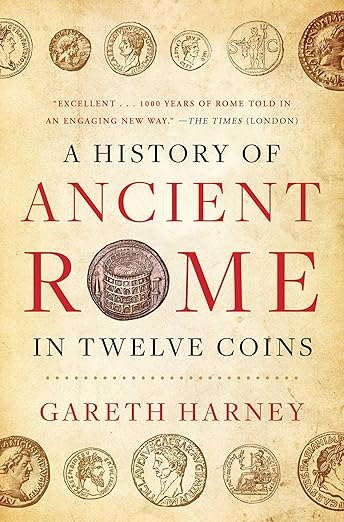
A History of Ancient Rome in Twelve Coins

Gareth Harney

2024Non-Fiction General History

Harney, the historian behind the Optimo Principi account, uses twelve surviving Roman coins as portals into twelve pivotal moments — from the founding myths to the fall — showing how a piece of pocket metal can carry an entire empire's propaganda, economics, and self-image.

The Fall of Rome: A Novel of a World Lost

Michael Curtis Ford

2007Fiction Fall of Rome — Odoacer

A novel of 476 AD: the rivalry between the Roman general Orestes and the barbarian warlord Odoacer, ending with the deposition of the last western emperor — a child named, fittingly, Romulus Augustulus.